
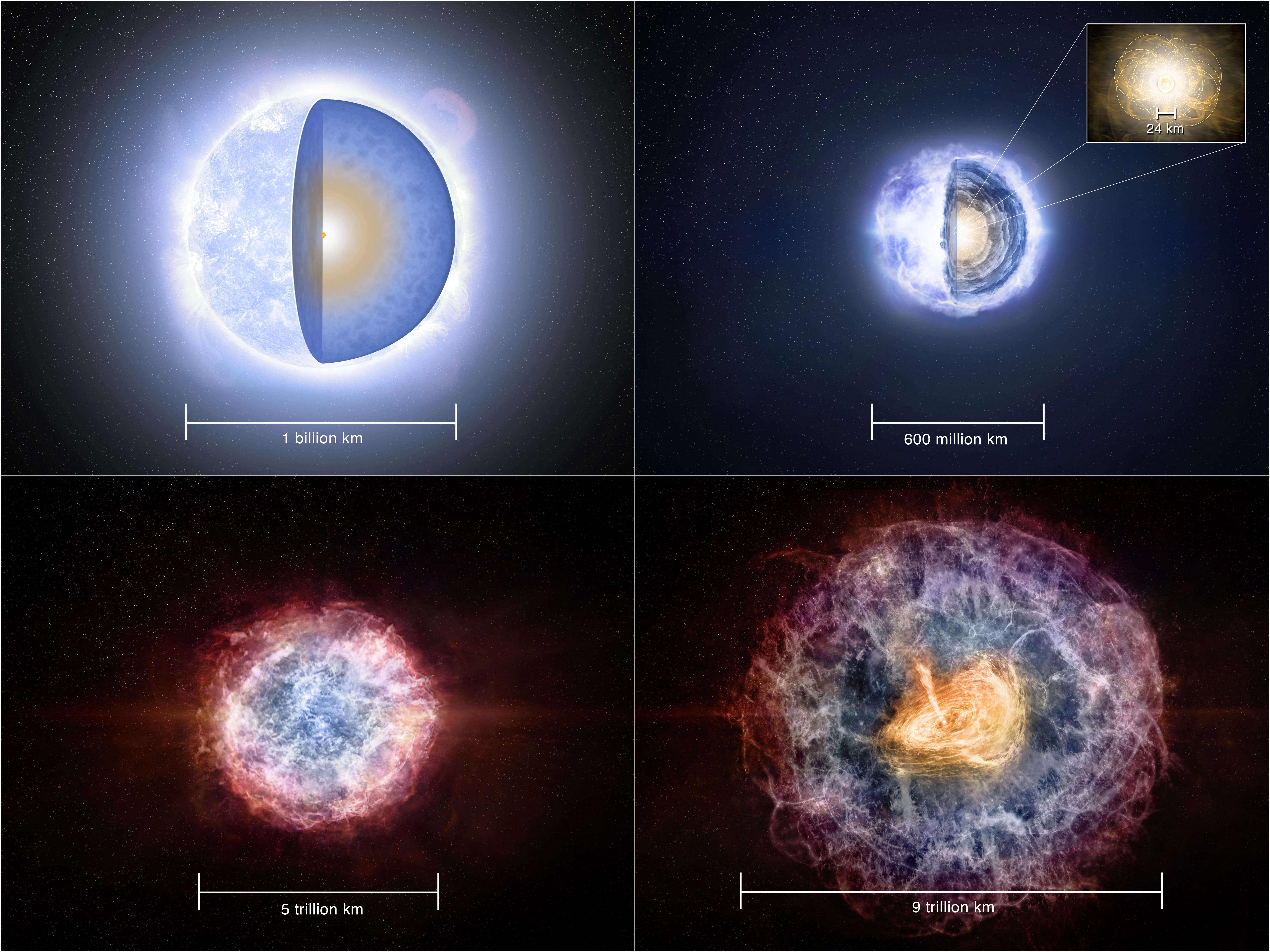
These artist’s conceptions illustrate the sequence of events in VT 1137-0337. Top Left: A giant blue star, much more massive than our Sun, has consumed, through nuclear fusion at its center, all its hydrogen, helium, and heavier elements up to iron. It now has a small iron core (red dot) at its center. Unlike the earlier stages of fusion, the fusion of iron atoms absorbs, rather than releases, energy. The fusion-released energy that has held up the star against its own weight now is gone, and the star will quickly collapse, triggering a supernova explosion. Top Right: The collapse has begun, producing a superdense neutron star with a strong magnetic field at its center (inset). The neutron star, though containing about 1.5 times the mass of the Sun, is only about the size of Manhattan. Bottom Left: The supernova explosion has ejected a fast-moving shell of debris outward into interstellar space. At this stage, the debris shell is dense enough to shroud from view any radio waves coming from the region of the neutron star. Bottom Right: As the shell of explosion debris expands over a few decades, it becomes less dense and eventually becomes thin enough that radio waves from inside can escape. This allowed observations by the VLA Sky Survey to detect bright radio emission created as the rapidly spinning neutron star’s powerful magnetic field sweeps through the surrounding space, accelerating charged particles. This phenomenon is called a pulsar wind nebula.
Client
National Radio Astronomy Observatory
Project Type
Science Visualization
Category
Astrophysics
Credit
Melissa Weiss, NRAO/AUI/NSF

My work with Dillon Dong was an interesting challenge. The goal was to visualize progression in static images. In order to do that we did a lot of experimenting which required a lot of back and forth to get it just right.

Sometimes the information requires more than a single image. The main goal is to convey the important findings in images that can be easily translated by an audience that is coming to the information for the first time, and with very little context. The visual results are meant to be a partner to the press releases to help inspire and pull the reader in for more details.